
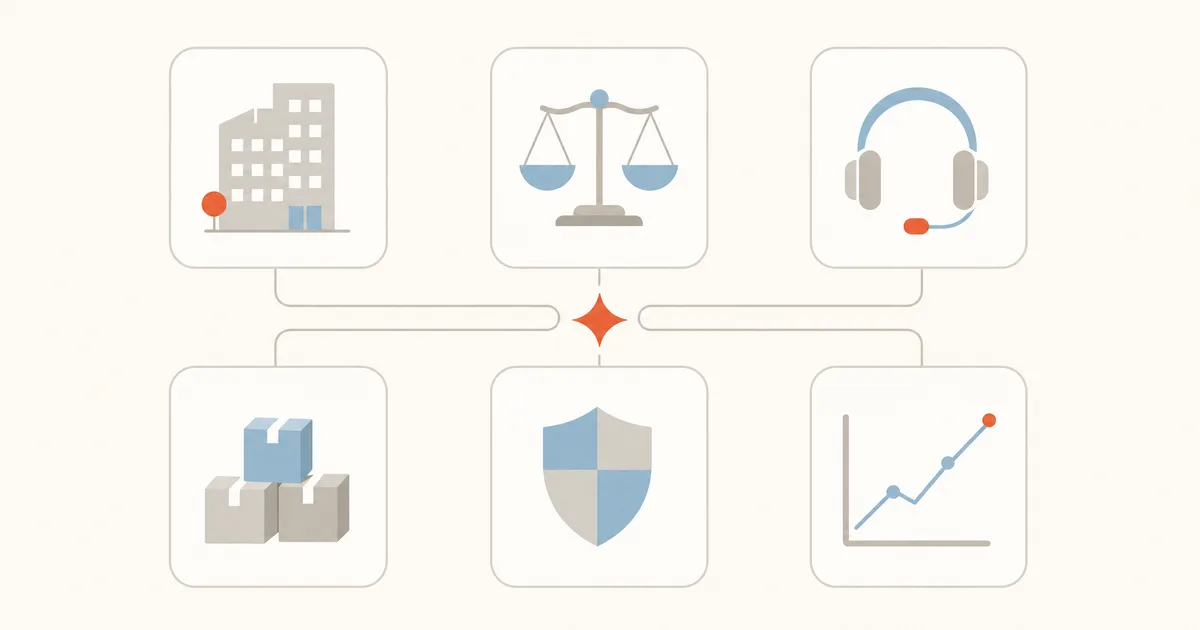
Strip away the headlines and AI adoption across industries is surprisingly uniform. Whatever the sector, the hours AI recovers come from the same four activities: reading and extracting (documents into data), sorting and routing (what is this, who handles it), drafting (the first version of a reply, report or contract), and watching (monitoring streams of events a human can't keep up with). Industries differ only in what gets read, routed, drafted and watched.
That's good news for any company evaluating AI: you don't need to find an exotic use case. You need to find where your team does those four things by hand.
The pattern, sector by sector
Finance teams
Invoices, bank statements and expense reports are read and booked automatically; reconciliation exceptions — not the whole ledger — get human attention; cash-flow reporting assembles itself on schedule. The pattern in practice: finance use cases.
Legal and compliance
Contract review shifts from reading everything to reviewing flagged clauses; obligations and deadlines are extracted and tracked automatically; regulatory changes are monitored instead of discovered late. See legal and compliance use cases.
Customer support
Tickets classify and route themselves; answers to known questions are drafted from the knowledge base; humans handle the cases that actually need a human. See customer support use cases.
Operations and logistics
Order confirmations, delivery notes and supplier messages flow into systems without retyping; anomalies in deliveries or stock levels surface as alerts instead of next week’s surprise. See operations use cases.
Security
Alert triage — the most fatiguing job in a security team — is exactly the sorting-and-routing pattern: AI handles the noise, analysts get the signal with context attached. See security use cases.
What the gains actually look like
We deliberately quote no industry-average percentages — they vary wildly with process quality and data access, and most published numbers don't survive contact with a specific company. What we can say from built projects: the wins are largest where volume is high and judgment per item is low, the first automated process typically frees up hours per person per week rather than minutes, and the second process is much cheaper than the first because the integration groundwork already exists.
The compounding effect matters more than any single number. Each automated process produces structured data the next one can build on — the invoice extractor feeds the cash-flow report, the ticket classifier feeds the product-quality dashboard.
Why smaller companies gain the most
Counterintuitively, mid-sized companies often see more relative impact than enterprises. Three reasons: their people wear multiple hats, so removing routine work returns capacity where it's scarcest; their processes are short enough to automate end-to-end instead of in fragments; and they can decide and deploy in weeks. The enterprise advantage — dedicated AI teams and budgets — matters less now that the underlying models are rented, not built.
A realistic first 90 days
- Weeks 1–2: map where the four activities (read, sort, draft, watch) consume the most hours; pick one process with high volume and a cheap cost of error.
- Weeks 3–8: build and ship that one automation, with humans reviewing everything at first and autonomy widening as the logs justify it.
- Weeks 9–12: measure honestly — hours recovered, error rates against the manual baseline — and choose the second process from a position of evidence.
If you want the mapping done with engineers who build these systems, our analysis and research service does exactly that, and our use cases library shows what the destination looks like across nine industries.