
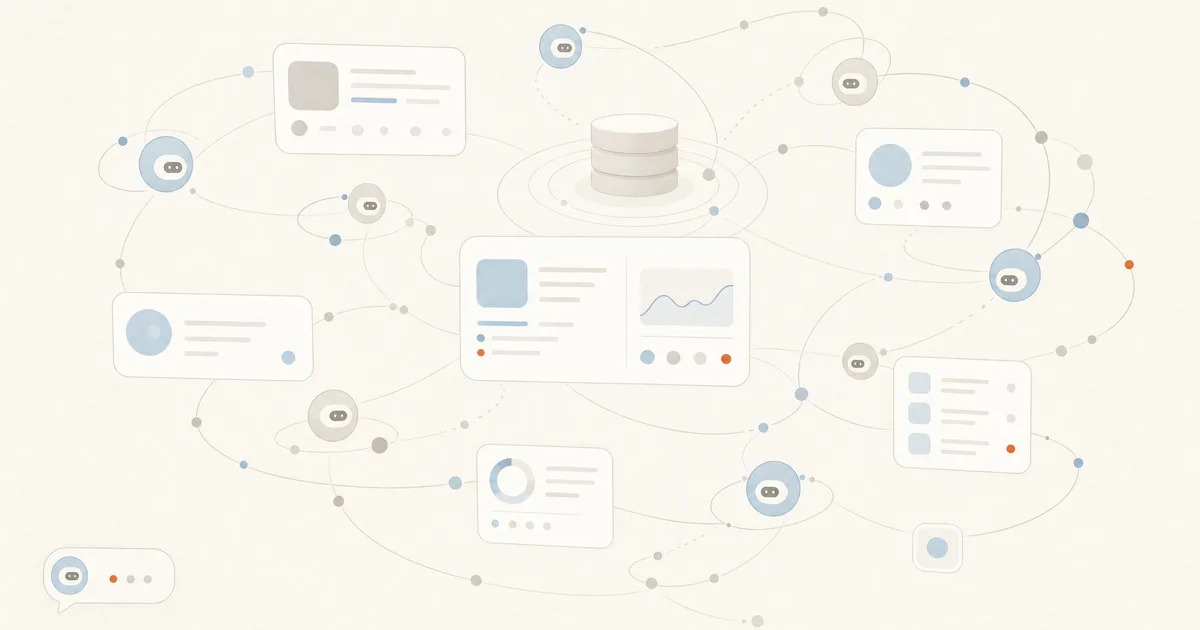
Ask most people what AI in a company looks like and they describe a chat window: a person types a question, the model types back. That mental picture is two generations out of date, and it quietly undersells what's worth buying. The deployments that actually move numbers don't wait for anyone to type. They run in the background — on schedules, on triggers, on events — and they operate real systems, not just conversation.
From answering to acting
A chat assistant answers when asked. An agent is the same intelligence wired differently: it has a standing job, access to tools, and rules about what it may do alone. The shift is from "AI that knows things" to "AI that does things" — and crucially, nobody has to remember to invoke it.
- Schedule-driven — every morning at six, assemble yesterday's sales numbers from the ERP, flag anomalies, and post the digest before the team sits down.
- Event-driven — an invoice arrives in the inbox: extract it, match it to a purchase order, book it or escalate it. A negative review appears: draft the response and alert the owner.
- Threshold-driven — stock for a top product falls below two weeks of cover, a server error rate spikes, a contract enters its notice window — the agent notices and acts on standing instructions.
Tool use: how a model operates real systems
The mechanism behind this is tool use. The model doesn't just produce text — it's given a catalog of operations it may call: query this database, search these tickets, create a CRM record, send this email, call this internal API. The model decides which tool fits the task, calls it, reads the result and continues. That loop, repeated, is what turns a language model into a worker rather than an oracle.
Tool use is also where the engineering lives. Every tool is a boundary you control: what it exposes, what it refuses, what it logs. The model is never trusted with more than the tools allow — which is exactly how it should be.
MCP: a standard plug between AI and your systems
Until recently, every AI integration was bespoke: connecting a model to your CRM meant custom glue code, and switching models meant rewriting it. The Model Context Protocol (MCP) — an open standard introduced by Anthropic in 2024 and since adopted across the industry — fixes this. A system exposes its capabilities once, as an MCP server; any MCP-capable model or agent can then discover and use them.
Think of it as USB for AI integrations. For a company, that has three practical consequences:
- Integrations stop being throwaway — the MCP server you build for your ERP serves every current and future AI tool, not one vendor's chatbot.
- Vendor lock-in weakens — models become swappable behind the same tool layer, so you can follow quality and price.
- Access control gets a natural home — the MCP server decides what any AI may see and do, in one audited place.
What this looks like in practice
Most of our use case prototypes are agents in exactly this sense — a phishing triage agent that processes reported emails as they arrive, a receivables agent that chases overdue invoices on its own schedule, a tenant communication agent that handles requests end to end. Our Cosmos platform exists to assemble such systems quickly from proven blocks — authentication, logging, mail processing, AI assistants — instead of building every project from zero.
Oversight is a feature, not a limitation
Autonomous does not mean unsupervised. A production agent has explicit permissions (what it may do alone, what needs approval), an audit trail of every action and the reasoning behind it, confidence thresholds that route uncertain cases to a person, and a kill switch. These guardrails aren't bureaucratic overhead — they're what makes it rational to hand real work to software. You wouldn't hire an employee without defined responsibilities either.
If a process in your company runs on someone remembering to check something, that’s an agent waiting to be built. Designing them is the core of our AI agents service, and AI integrations — increasingly MCP-based — connect them to the systems you already run.